Copy a Annotattoin Defined Template in a New Drawing Autocad
In the first challenge, you have examined your drawings. This should give you enough insight what you can improve in our challenges. We will start to work with AutoCAD template in this challenge.

Why AutoCAD template is important
When we create a drawing, you will use same settings, objects and object properties. We use and create them repeatedly.
If you don't have your own template, you probably use default templates that are provided by Autodesk. The default template is empty. You will need to create layers, create and modify annotation styles, setup layout and other tasks.
You can put all common information to a template. Therefore, when you start a new drawing, all settings are ready. You can immediately focus on what you are going to draw.
What Can a Template File Do?
Snipped from Brian Benton's article, Why You Should Use Template:
Template files provide users a place to start. Not only do they give a starting point, but they also force your team to be a team. A properly executed template file, or series of template files, will instill standardization increase efficiency. Standards are created and enforced because the template file comes preset with plot styles, layers, blocks, styles, and more. Since these drawing attributes are preinstalled, it also creates efficiency. And since these features are preset, CAD Standards are automatically implemented and enforced.
Create a new template
I found that common mistakes in creating a drawing is to start from a wrong template. You can create a new file from default template. Make sure you choose the right one.
AutoCAD has two types of measurement, imperial and metric. Choose the one that you use. Metric template has ISO in the file name. If it doesn't have it, then it's an imperial template.
The other consideration is to choose it by the plot style. AutoCAD has two types of plot style: color based (CTB) and named plot style based (STB). Mark Kiker has excellent article comparing CTB and STB here.
And never create a template by copy or save as your existing drawing!
Change settings
AutoCAD save system variable in two locations: registry and drawing. If there are settings that you want to keep in all drawing, set it in your template.
A popular example of this type of setting is GRIDMODE.
Add layers to a template
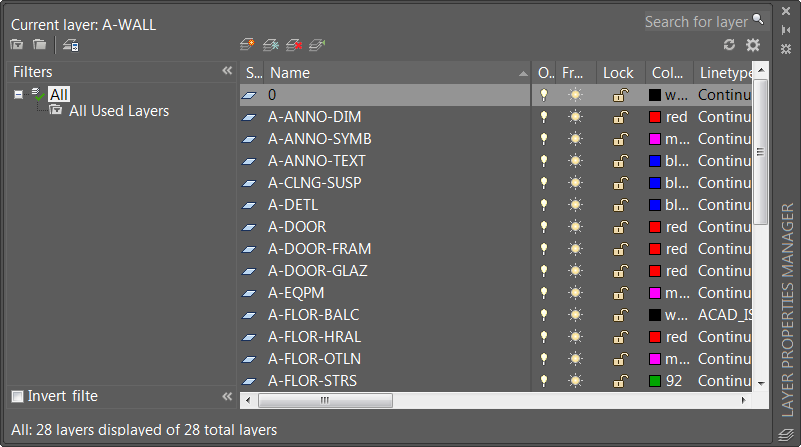
Adding layers to a template is easy, but it is a very tedious task. But remember, this time you will only do it once.
If that is still not compelling for you, you can copy layers from your existing drawings by using Design Center. There are also LISP program that can help you to create layers. Like this LISP to create AIA layers from AUGI.
You probably can find a template that you can download. But you need to make sure it will work well for you.
Managing layers
The downside of using default layers is you can have so many layers in your drawings. You and your team will need help to manage them.
AutoCAD has two features to avoid overwhelming number of layers: layer filter and layer states.
Layer filter will help users to see only what they need in layer manager and layer dropdown. You can define several filters. Define them based on your tasks in your template. Design and Motion has excellent article about AutoCAD layer filter here.
Layer states allows you to change layer properties quickly. You can turn on and off many layers at once if you use layer states. You can also change the layer properties like colors and line weight with layer states. This is useful if you need to plot with different line weight in different scales.
Check this article on Design and Motion to learn more about AutoCAD layer states.
Add Annotation Styles to your template
AutoCAD has many annotation styles. There are text styles, dimension styles, table styles and so on. Styles save settings for our annotations. Not only efficient, it will make annotations look consistent.
The number of annotation styles you need depends on how you add annotations. If you add annotations in layout, you may need less. If you add annotations in model space, you may need to have more styles. Some AutoCAD has different styles for different plot scales.
Another method that you can use is to use annotation scaling. You only need one style for different plot scales, even if you work in model space. If you are not familiar with annotation scaling yet, you can learn more about annotation scaling here.
Define page setups
You can save layout settings in page setups. Not everyone uses layout. But if you do, you can define your page setups in templates.
If you have many layout settings, you can save it in separate templates. You don't have to put everything in a single template. You can create layout by importing it from other template. This will make your file more efficient and small.
If you don't use layout, you may want to check 10 reasons why you should use it here.
Save and use the template
After you are finished, now save this file as a template. You may want to save it in custom location or server.
If you save it in custom location, don't forget to change the drawing template location in AutoCAD option. It will make you easier to access it. This option only allow you to add one location. If you have several locations, you can add more file location in open/save dialog box.
You may also need to change the default template for QNEW.
Discuss with us

In this challenge, you created AutoCAD templates. You may need more than one template. The templates should be able to help you to reduce repetitive tasks. But having too many settings and objects in one file will be counterproductive. It will be confusing and your files will be prone to corrupt.
Now share with us, what do you have in your template? Is there anything else you can suggest us to put in a template?
Do you have any problems completing this challenge? If you already have templates, do you think you can make some improvements?
Do you know any resources that we can use to create templates or to download AutoCAD templates?
How many templates do you have? Why do you need more than one template? Is it because you use more than one standard? Or to keep it simple?
Let's discuss it here. Any discussion about template is welcome.
Remember, we have prizes for active participant at the end of this program. So make sure you join the discussion!
If you are finished, try to complete the 3rd challenge: Create reusable content.

Source: https://www.cad-notes.com/wbwa-challenge-2-template/
0 Response to "Copy a Annotattoin Defined Template in a New Drawing Autocad"
Postar um comentário