Only in the Wilderness
"Exodus 25–thirty; 35–forty: The House of the Lord in the Wilderness," Quondam Testament Student Manual Genesis-2 Samuel (1980), 146–56
(13-one) Introduction
Out of the thunders of Sinai the Lord revealed a glorious plan by which He could redeem the children of State of israel. The Lord opened the heavens to Moses and through him extended to Israel the opportunity to come to a fulness of His glory, taste of His love, and truly get a Zion people (see Exodus 25:viii; 29:43; D&C 84:23–27). During his forty-mean solar day fast upon the mountain, Moses received every particular needed for the construction of a tabernacle, a firm of the Lord, where State of israel could come and receive the keys of salvation and exaltation.
The tie betwixt this tabernacle and latter-day temples is unmistakable. Similar modernistic temples, the tabernacle was to be a house wherein "every needful thing" could be found (D&C 109:fifteen). It would be a business firm of prayer, a house of fasting, a house of faith, a firm of glory and of God, then that "all the incomings of thy people, into this house, may be in the name of the Lord; that all their outgoings from this firm may be in the name of the Lord" (D&C 109:16–eighteen; see likewise Leviticus ix:23; 10:8–eleven). Thus, through the ability of revelation, Israel could exist "taught words of wisdom" and "seek learning fifty-fifty by report, and also by faith" (D&C 109:14).
Deep pregnant is associated with the physical dimensions and programme of the tabernacle. They were meant to reflect spiritual patterns that are also reflected in temples today. Prayerful study and meditation will assistance you to comprehend the importance of this ancient domicile identify of the Lord.
Notes and Commentary on Exodus 25–30; 35–40
(13-2) Exodus 25–30; 35–xl. Why Are At that place Two Accounts in Exodus of the Tabernacle?
While on Mountain Sinai, Moses received the revelation detailing the plans for the tabernacle (come across Exodus 25–xxx). When he came downwards, Moses gathered State of israel and they began the actual structure of the tabernacle (see Exodus 35–40). Since Moses used the revelation to guide the construction, in that location is a close parallel betwixt the two descriptions in Exodus. (Note: For purposes of commentary here, the focus will be on Exodus 25–30, the revelation capacity, and significant additions recorded in the structure chapters will be noted every bit necessary.)
(13-3) Exodus 25:one–9. A Willing Heart
Information technology is significant that, earlier revealing the blueprint of the tabernacle itself, the Lord told Moses that Israel had to demonstrate a willingness to sacrifice to build His sanctuary (meet v. 2). Mormon taught that if a gift of sacrifice is offered to the Lord with a grudging attitude, non only is it non acceptable to the Lord, but it becomes an evil act (see Moroni seven:vi–10). Unless State of israel had the right attitude nigh the sacrifice of their materials, it would do them no skillful. Modern readers should remember that despite their other faults and failings (the golden dogie episode took place while Moses was on the mount receiving this revelation), when Israel heard what the Lord asked, they responded with joyous liberality. Their hearts were indeed touched (see Exodus 35:20–22, 25–26, 29), and finally Moses had to restrain them, for they gave far more than was needed for the tabernacle (meet Exodus 36:v–seven).
In Exodus 25:8 the Lord clearly revealed the purpose for the tabernacle—it was to be the house of the Lord. The Hebrew give-and-take which is translated "tabernacle" really ways "tent" or "dwelling" (Wilson, Old Testament Discussion Studies, s.v. "tabernacle," p. 434).
The phrase "according to all that I shew thee" (v. 9), seems to indicate that Moses was actually shown the tabernacle and its effects and not but given a verbal description.
The ephod (pronounced in Hebrew ay'fode) mentioned in verse vii is discussed in detail in Reading 13-13.
(thirteen-4) Exodus 25:ten. What Practice the Terms Shittim and Cubit Mean?
Shittim is pronounced shee-teem' in Hebrew and is used to designate a desert acacia tree known throughout Egypt and the Near E (see Smith, Dictionary of the Bible, s.v. "shittah tree, shittim," pp. 624–25). Because its hard forest endured well and besides took a loftier shine, it was ideal for the construction of the tabernacle.
The dimensions of the tabernacle are described in a unit of measurement of measure called a cubit, which is about eighteen inches in length. (The pupil should refer to the chart on weights and measures in Maps and Charts.)
Much of the furniture of the tabernacle was constructed of shittim wood and covered with gold leaf to give it the appearance of golden. Had the furnishings been made of solid gold, they would have been far also heavy to carry.
(13-five) Exodus 25:10–22; 37:1–9. The Ark of the Covenant
The ark of the covenant was a breast, or box, of shittim woods overlaid with gold. Information technology was approximately three feet 9 inches long, two anxiety three inches wide, and ii feet 3 inches high. Staves, or poles, on both sides allowed the priests to carry it without really touching the ark itself. Inside, the tablets of the constabulary given to Moses on Mountain Sinai were placed (run across v. xvi). Hence, it was called the ark of the testimony or ark of the covenant. Later on, a pot of manna and Aaron's rod, which miraculously bloomed, were too placed within the ark (see Hebrews 9:4). The ark was placed inside the inner room of the tabernacle known as the almost holy place, or Holy of Holies. The ark was viewed with the greatest reverence by the Israelites, and prayers were recited before it was moved or placed in position (encounter Numbers 10:35–36).
The chapeau, or covering, for the ark is described in Exodus 25:17–22. The Rex James Version translates the Hebrew word kapporeth (which means "seat of amende") as "mercy seat." The covering was made of solid gold and on information technology were formed two cherubim with wings which came up and overshadowed the lid or mercy seat.
The give-and-take cherubim usually refers to guardians of sacred things. While the exact meaning of the word is not known, most scholars agree that these cherubim represented "redeemed and glorified manhood" or "glorified saints and angels" (Wilson, Erstwhile Attestation Word Studies, s.v. "cherubim," p. 75). Since Latter-day Saints do not believe that angels have wings, as they are oft shown in religious fine art, the commandment to form wings on the cherubim may raise some questions. Another revelation indicates, however, that wings symbolically represent the power to motility and to act (see D&C 77:four). Between these cherubim on the mercy seat, God told Moses, He would meet with him and district with him. Latter-day revelations state that angels stand every bit sentinels guarding the presence of God (run into D&C 132:19).
The blood of the lamb of Jehovah was sprinkled upon the mercy seat during the sacred mean solar day of Atonement. (For a complete discussion of the sacred significance of this issue, see Reading 15-8.) Paul and John both spoke of Jesus every bit beingness "the propitiation" for our sins (run into one John two:two; 4:x; Romans 3:25). The Greek discussion hilasterion, translated "propitiation," was also used to translate the Hebrew kapporeth ("seat of atonement") in the Greek Old Testament. Ane scholar discussed the significance of the word hilasterion:
"All Greek nouns which end in -erion hateful the place where something is washed. Dikasterion ways the identify where dike, justice is done, and therefore a law court. Thusiasterion means the identify where thusia, sacrifice is washed, and therefore the chantry. Therefore hilasterion can certainly mean the place where hilasmos, expiation, is washed and fabricated. Because of that, both in the Old and New Testament, hilasterion has a regular and a technical meaning. It ever means the lid of gold above the ark which was known every bit the mercy-seat. In Exodus 25:17 it is laid down of the furnishings of the tabernacle: 'M shalt make a mercy-seat (hilasterion) of pure gold.' In simply one other identify in the New Testament is the word used, in Hebrews ix:5, and there the writer speaks of the cherubim who overshadow the mercy-seat. The word is used in that sense more than xx times in the Greek One-time Testament. …
"If then we accept hilasterion to mean the mercy-seat, and, if we call Jesus our hilasterion in that sense, information technology will mean, and so to speak, that Jesus is the place where homo and God meet, and that specially He is the identify where man'southward sin meets with the apologetic beloved of God." (Barclay, The Mind of St. Paul, pp. 87–88.)
Clearly, and so, the ark of the covenant was one of the most significant features of the tabernacle, both in its importance to ancient Israel and also in its symbolic significance.
(13-half dozen) Exodus 25:17. What Was the Significance of the Use of Gold in the Tabernacle and Its Furnishings?
Gold has been highly treasured by men from the primeval times and thus has symbolic as well as monetary significance. "Gold is oftentimes employed in Scripture equally an emblem of what is divine, pure, precious, solid, useful, incorruptible, or lasting and glorious" (Fallows, Bible Encyclopedia, south.v. "gold," ii:723). This symbolism clearly explains the use of gold in the ark of the covenant.
Silver and contumely also were used in other parts of the tabernacle and its furnishings. These two metals have symbolic equally well as functional significance. The Encyclopaedia Judaica notes:
"The relativity of holiness was further pointed up by the materials. Fine or pure gold was used for the Ark, the propitiatory, the table of the Presence and its vessels; for the lampstand and its accessories; for the altar of incense; and for the high priest's garments. Ordinary gold was employed for the moldings, the rings, and the staves of the Ark, of the tabular array, and of the incense altar; for the hooks of the curtains; for the frames and bars; for the pillars of the veil and screen; and for other parts of the high priest's vestments. Silvery was reserved for the bases of the frames, for the pillars of the veil, and for moldings in the courtroom. Finally there was bronze, of which metal the altar of burnt offering and its utensils, the bases of the court, and the laves were made. The same principle applied to the embroidered stuff and linen.
"The theme of gradation was connected in respect of the three divisions of the people. The Israelites could enter the court but; the priests could serve in the Holy Place; the loftier priest solitary could enter the Holy of Holies simply one time a year—on the Day of Atonement." (Southward.5. "tabernacle," 15:687.)
(13-7) Exodus 25:23–30; 37:10–16. The Table of Shewbread and Its Instruments
The 2d commodity of piece of furniture described by the Lord was the tabular array of shewbread. Like the ark of the covenant, it too was to be made of shittim woods with a gold overlay (run into vv. 23–24). It had a crown and border (probably a rim) of gold on the summit, or surface, of the table and had rings and staves to provide for like shooting fish in a barrel transport. Information technology was virtually 3 feet long, eighteen inches wide, and twenty-seven inches high. Diverse vessels of gilded, called the spoons, dishes, covers, or bowls in the King James Version of the Bible, were made for use with the table.
This table got its proper name from the twelve loaves of bread which were placed upon information technology. The Lord called it "shewbread" (v. 30), which translates literally the Hebrew word significant "the bread of faces," or "the staff of life of the presence," signifying that this bread was placed earlier the face of the Lord or in His presence (Wilson, Sometime Attestation Word Studies, s.five. "shew, shew-bread," p. 388; Hastings, Dictionary of the Bible, s.five. "shewbread," p. 847). The bread was made of fine flour (that is, the wheat had been very finely ground and not left with the kernels partially intact) into twelve loaves of considerable size—2-tenths of a deal would be about a fifth of a bushel of flour (see Leviticus 24:v; Hastings, Dictionary of the Bible, s.5. "shewbread," p. 847). Thus, the cakes would likely accept weighed over 10 pounds each. The loaves were put into two stacks, and upon each pile was placed pure frankincense that was later on burned on the altar of incense "an offering made past burn unto the Lord" (Leviticus 24:7; run into besides 5. 6). The bread was changed each Sabbath and the bread that was removed was eaten past the priests (encounter Leviticus 24:eight–9). This was the staff of life given to David when he fled from King Saul (meet one Samuel 21:1–6; Matthew 12:4).
Most scholars and former Jewish traditions agree that wine was besides placed on the table along with the breadstuff, although information technology is non mentioned specifically in the biblical account. The spoons were actually vessels or cups, rather than spoons as they are known today, and were probably the containers for the liquid. (See Fallows, Bible Encyclopedia, southward.five. "shewbread," iii:1576; Hastings, Lexicon of the Bible, s.5. "shewbread," p. 847.) Thus, the items placed on the table of shewbread have distinct parallels in the emblems of the sacrament.
(13-8) Exodus 25:31–40; 37:17–24. The Golden Candlestick
The source of light for the tabernacle was the sacred candlestick. Chosen menorah in Hebrew, which ways the "place of lights" (Fallows, Bible Encyclopedia, s.v. "candlestick," ane:332), it held non candles but rather seven cup-shaped containers filled with pure olive oil into which a wick was inserted and lit. Made of solid gold, the menorah was supported by a base of operations which rested upon 3 feet. Its shaft rose from the base of operations which was decorated by knops (spherical ornamentations), bowls (enlargements proportionate in size to the knops and upon which were almond blossoms), and flowers (disc-like enlargements representing the shape of an almond flower petal). Each of the branches of the menorah was crowned with a light which illuminated the holy place, or first room of the tabernacle.
The number seven has sacred significance in the Old Testament, connoting wholeness or perfection (see Smith, Dictionary of the Bible, s.5. "seven," pp. 607–8; Douglas, New Bible Dictionary, due south.v. "numbers," p. 898). Thus, the light provided in the house of the Lord symbolized the perfect light.
The oil for the seven lamps had to be pure olive oil (come across Exodus 27:xx) that had been consecrated for that purpose. The Jewish festival of Hannukah, or the festival of lights, celebrates the time when Judas Maccabeus finally drove the Greeks from the temple in Jerusalem around 165B.C. According to Jewish tradition, the Maccabees found only enough consecrated oil for the sacred lamps to terminal ane day. The induction of new oil took eight days; nonetheless miraculously, the meager supply burned until a new supply could be properly prepared. (Encounter Josephus, Antiquities of the Jews, bk. 12, chap. 7, par. 6.)
Other scriptures indicate that olive oil represents the Holy Spirit, probably because it provided fire, estrus, and lite when burned in the lamps (meet D&C 45:56–57). Thus, the sacred menorah was a type or symbol of the true source of spiritual light, namely the Holy Ghost as He bears witness of the Father and the Son.
(13-nine) Exodus 26:ane–14; 36:8–38. The Coverings for the Tabernacle
Because the Israelites were wandering in the wilderness at this time, the tabernacle had to be portable. The walls were formed of panels that could be joined together (see Exodus 25:15–16). And so the walls and open ceiling were covered with four different layers of cloth.
The inner fabric was made of fine-twined linen. The Hebrew word translated "linen" signifies not only the textile but also "whiteness" (Wilson, Old Attestation Word Studies, south.v. "linen," p. 255; see also Fallows, Bible Encyclopedia, southward.5. "linen," two:1068). Scholars believe it was either a fine cotton fiber cloth or one made from flax. Because of the length of the tabernacle, ten defunction, or pieces of fabric, were needed to cover it. This inner layer was to take cherubim (angels) embroidered upon information technology and was to incorporate, likewise the whiteness, the colors blue, regal, and cerise.

The tabernacle in the wilderness
The selvage of these defunction was a special border at the border of each woven piece that prevented raveling. This edge was commonly of different size threads and was sometimes of a different weave than the rest of the drape.
Past means of golden clasps or pins called taches, the selvages of next curtain segments were joined together, creating the appearance of a single mantle over the tabernacle.
The other iii fabrics consisted of goats' hair, rams' skins dyed ruddy, and badgers' skins (see Exodus 26:seven, 14). The nature of the last kind of material is not articulate; scholars seem to agree only that information technology was not the skin of badgers. The Hebrew word implies the color of, more than the kind of, textile (see Wilson, Old Attestation Word Studies, s.v. "badger," p. 27). Some scholars believe it may have been the skins of porpoises or seals from the Red Sea which would accept given the tabernacle a waterproof outer covering (run into Keil and Delitzsch, Commentary, one:2:163).
(13-10) Exodus 26:15–30. What Were the Tenons and Sockets?
The tenon was one of two large rectangular dowels at the lesser stop of each board. The tenon fitted into a double base support called a socket that could skid up and downward each tenon independently. Since all of the boards were attached firmly side to side, making a rigid wall, every socket could residue on the basis even when information technology was irregular. 1 is immediately impressed with the particular that the Lord gave Moses concerning His dwelling house identify.
(13-xi) Exodus 26:31–37
The two veils, or hangings for the door, described hither are the outer door to the tabernacle (the front archway) and the veil which separated the holy identify, or first room, from the inner Holy of Holies. This latter veil is properly called the veil of the tabernacle.
(thirteen-12) Exodus 27:i–19; 30:17–21; 38:1–twenty. The Outer Courtyard and Its Furnishings
Surrounding the tabernacle itself was a large enclosed area protected by woven hangings attached to a movable wall. In this courtyard was located the altar of burnt offerings (chantry of sacrifice) and the laver of h2o for the symbolic cleansing of hands and feet. Into this courtyard anyone of Israel could bring sacrifices, but only the priests could enter the tabernacle itself. (Sometimes, however, the tabernacle referred to in the Old Testament ways the whole circuitous, including the courtyard, and not just the tent itself.)
Each colonnade of the court of the tabernacle was ringed horizontally past silver fillets, which were rectangular bands around each pillar to both protect the wood and beautify it. The hangings, or the fabric which formed the outer walls of the court, were fastened to the top of each pillar and were secured at the lesser by ties to the brass pins which were firmly driven into the ground. The following were the furnishings of this outer court:
Chantry of burnt offerings. All burnt offerings performed inside the tabernacle took place on this altar. It was hollow, v cubits square and three cubits loftier, or well-nigh seven½ x seven½ 10 5 feet in dimension. It was made of shittim forest overlaid with brass plates.
Information technology had four horns on its corners. Upon these horns the claret of the sacrifice was to be smeared. By laying concur of these horns, a person could find asylum and safety (see i Kings i:50; 2:28), although not if he was guilty of premeditated murder (see Exodus 21:14). Sometimes the horns were used to bind the animal or intended sacrifice.
Holy instruments of sacrifice. The pan was a large, brazen dish placed under the chantry to receive the ashes every bit they fell through.
Brazen fire shovels were used for emptying the pans.
The basons were receptacles used to catch the blood from the sacrifice.
The fleshhook was a three-pronged hook that the priest used to dip into the sacrificial container. That which he brought upwardly was to be kept for himself.
The firepan was the container in which was kept the continuously burning burn for cede.
Laver. This, similar the altar of cede, was made of brass. It stood between the chantry of sacrifice and the tabernacle. It was used by the priests for cleansing, preparatory to inbound the tabernacle.
In Solomon's day, when a permanent temple was constructed, the laver was set on the backs of twelve oxen (run into 1 Kings 7:23–26).
(xiii-13) Exodus 28; 39. The Priesthood Garments and Their Significance
When the children of State of israel forfeited their right to the higher priesthood and its associated blessings and responsibilities, the Lord established the Levitical Priesthood among them (see D&C 84:18–27). Through this social club of the priesthood State of israel enjoyed the principles of the preparatory gospel. They were reminded continually of the atoning cede of the Savior, who was symbolically represented before them in the person officiating as priest (run into Leviticus viii:5–10; 21:10; Hebrews 5:4; 7:11–12, 21; D&C 107:1, xiii–20; JS—H, 1:68–72).
The design for the official clothing of the high priest, or presiding caput of the Aaronic Priesthood (not the Melchizedek Priesthood office of high priest), was given by revelation and had symbolic as well as practical significance. It consisted of the post-obit items:
Ephod. "The ephod [pronounced ay'fode in Hebrew] was an commodity of sacred clothing worn past the high priests of the Levitical Priesthood. The Lord directed that they were non to wear ordinary clothing during their service, merely they were to accept 'holy garments' made by those whom the Lord had 'filled with the spirit of wisdom.' (Exod. 28:2–3.) These sacred garments were to be passed from father to son along with the high priestly office itself. (Exod. 29:29.)
"The ephod, worn over a blue robe, was made of blue, purple, and ruby material, with designs of gold thread skillfully woven into the material. This garment was attached at each shoulder and had an intricately woven band with which it could be fastened around the waist. In gilded settings on each shoulder were onyx stones engraved with the names of the 12 sons of State of israel every bit a 'memorial' as the priest served before the Lord. (Meet Exod. 28:6–14 and 39:2–7). Attached to the ephod was a breastplate into which the Urim and Thummin could be placed. (Exod. 28:15–xxx.)
"The exact function of the ephod is not known. Every bit President Joseph Fielding Smith observed, information concerning these ancient ordinances 'was never recorded in any detail, considering such ordinances are sacred and not for the world.' (Improvement Era, November 1955, p. 794.)" (Richard O. Cowan, "I Have a Question," Ensign, December. 1973, p. 33.)
This "apron," as it is sometimes translated, signified a beautiful symbolic concept. With the ii onyx stones, which fastened the ephod on the shoulders, the high priest (a type of Christ and also of His authorized representatives) entered the tabernacle (the house of the Lord, or God'due south presence) carrying Israel on his shoulders (see Exodus 28:12).
The breastplate. Attached to the ephod with golden chains and ouches (sockets or fasteners) was the breastplate (run across vv. 13–29). The breastplate worn past Aaron and subsequent high priests should not exist confused with the i used past the Prophet Joseph Smith in translating the Book of Mormon. Aaron's breastplate was made of fabric rather than of metal and was woven of the same cloth that was used in making the ephod (see 5. 15). Information technology was twice every bit long equally it was wide and when folded became a square pocket into which the Urim and Thummim was placed. Upon the exposed half of the breastplate were precious stones inscribed with the names of each of the tribes of Israel. Thus, the high priest bore "the names of the children of Israel in the breastplate of judgment upon his heart … for a memorial before the Lord continually" (v. 29).
The symbolism of the loftier priest carrying Israel next to his center lends added meaning to the promise that the Lord will some day select His "jewels" (D&C 60:4; 101:3).
The Urim and Thummim. Every bit noted higher up, the Urim and Thummim was carried in the pouch formed when the breastplate was folded over (see Exodus 28:30).
"A Urim and Thummim consists of 2 special stones called seer stones or interpreters. The Hebrew words urim and thummim, both plural, mean lights and perfections. Presumably one of the stones is called Urim and the other Thummim. Ordinarily they are carried in a breastplate over the center. (Ex. 28:30; Lev. eight:8.) …
"… Abraham had them in his day (Abra. 3:one–4), and Aaron and the priests in Israel had them from generation to generation. (Ex. 28:xxx; Lev. 8:8; Num. 27:21; Deut. 33:eight, i Sam. 28:6; Ezra ii:63; Neh. 7:65.) …
"… Ammon said of these … stones: 'The things are called interpreters, and no man can wait in them except he exist commanded, lest he should expect for that he ought not and he should perish. And whosoever is commanded to expect in them, the same is called seer.' (Mosiah eight:13; 28:13–xvi.)
"The being and employ of the Urim and Thummim as an instrument of revelation will continue among exalted beings in eternity." (McConkie, Mormon Doctrine, pp. 818–nineteen.)
The Urim and Thummim of Aaron was not the aforementioned as that used past Joseph Smith, for the Prophet received the Urim and Thummim used by the brother of Jared (see McConkie, Mormon Doctrine, p. 819).
The robe. This robe was blue and was woven without seams with a hole for the head to go through (see Exodus 28:31–32). Jesus, the Great High Priest, was clothed in a like seamless garment prior to His Crucifixion (see John nineteen:23). Along the hem of the robe were placed, alternately, bells and fringes woven to look like pomegranates. One scholar noted the significance of the robe and its ornaments:
"[The robe was] woven in one piece, which set forth the idea of wholeness or spiritual integrity; and the night-blue colour indicated nada more than the heavenly origin and character of the office with which the robe was associated. [The true significance of the robe] must be sought for, therefore, in the peculiar pendants, the meaning of which is to be gathered from the analogous instructions in [Numbers xv:38–39], where every Israelite is directed to make a fringe in the edge of his garment, of dark-blueish purple thread, and when he looks at the fringe to recollect the commandments of God and do them. In accordance with this, we are also to seek for allusions to the give-and-take and testimony of God in the pendant of pomegranates and bells attached to the fringe of the loftier priest's robe. The simile in [Proverbs 25:eleven], where the word is compared to an apple tree, suggests the thought that the pomegranates, with their pleasant scent, their sugariness and refreshing juice, and the richness of their succulent kernel, were symbols of the word and testimony of God as a sweetness and pleasant spiritual food, that enlivens the soul and refreshes the centre [see Psalms xix:8–11; 119:25, 43, 50; Deuteronomy 8:3; Proverbs nine:8; Ecclesiastes 15:three], and that the bells were symbols of the sounding of this give-and-take, or the revelation and announcement of the word. Through the robe, with this pendant attached, Aaron was represented as the recipient and medium of the discussion and testimony which came down from sky; and this was the reason why he was non to appear before the Lord without that audio, lest he should forfeit his life [see Exodus 28:35]. It was not because he would just have appeared as a private person if he had gone without it, for he would always have the holy wearing apparel of a priest upon him, even when he was not clothed in the official decorations of the high priest; just because no mere priest was allowed to enter the immediate presence of the Lord. This privilege was restricted to the representative of the whole congregation, viz. the high priest; and even he could only do and then when wearing the robe of the word of God, as the bearer of the divine testimony, upon which the covenant fellowship with the Lord was founded." (Keil and Delitzsch, Commentary, 1:two:202–3.)
The golden diadem and the mitre. The mitre (or hat) was made of fine linen (encounter Exodus 28:39), and each priest wore one. In addition, the high priest wore a golden ring on the forepart of his mitre on the forehead. Engraved on the band were the words "Holiness to the Lord" (five. 36; see also vv. 37–38), signifying beginning that the high priest should exist characterized by this attribute, and second that Christ, the Great Loftier Priest, would be perfectly holy before God.
(13-14) Exodus 29
For clarification of the rites of purification for the priests and the explanation for the day of Atonement, see Enrichment Section D, "Feasts and Festivals."
(13-15) Exodus 29:vii
For the significance of the anointing with oil, encounter Reading 13-xviii.
(13-16) Exodus 29:xx. What Is the Meaning of Touching the Ear, Thumb, and Toe with Blood?
"The priest put some of [the] blood [from the offering] upon the tip of the right ear, the correct thumb, and the dandy toe of the correct pes of the person to exist consecrated, in club that the organ of hearing, with which he hearkened to the word of the Lord, and those used in interim and walking according to His commandments, might thereby be sanctified through the power of the atoning claret of the sacrifice" (Keil and Delitzsch, Commentary, 1:2:387–88, emphasis added).
(13-17) Exodus 30:ane–ten. The Altar of Incense
The third piece of furniture plant in the holy place forth with the sacred candlestick and the tabular array of shewbread was the chantry of incense. It stood straight in front end of the veil (see five. six). Similar the ark of the covenant and the table of shewbread, it was fabricated of shittim wood covered with gold and had rings and staves for carrying. Hot coals were placed on the altar, and each forenoon and evening (see vv. 7–8) the high priest would burn incense. This ritual seems to signify that one can approach the presence of God but through prayer, for scriptures elsewhere signal that incense is a symbol of prayer (see Revelation five:8; 8:3–4; Psalm 141:2).
(13-18) Exodus 30:22–33. Why Did the Lord Tell Moses to "Anoint the Tabernacle" and All Its Furnishings?
Pure olive oil was a sacred symbol of the Spirit of the Lord (run into D&C 45:56–57), and its use signified the sanctification of the person or object anointed (run across Exodus 30:29). The use of the oil tin also be an indication of the existing purity of the person, since the Spirit of the Lord will non dwell in an unclean tabernacle. President Joseph Fielding Smith said:
"The olive tree from the earliest times has been the emblem of peace and purity. It has, perhaps, been considered more nearly sacred than any other tree or form of vegetation by the inspired writers of all ages through whom we have received the word of the Lord. In parables in the scriptures the House of Israel, or the people who have made covenant with the Lord, have been compared to the olive tree." (Doctrines of Salvation, 3:180.)
Thus, to anoint fifty-fifty these inanimate objects with oil suggests that the tabernacle and all connected with it were sanctified past the Spirit in preparing them for service to God.
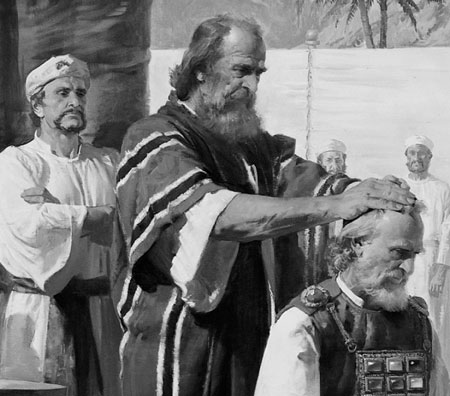
Moses ordained Aaron to preside over the priesthood.
Points to Ponder
(thirteen-19) In his opening accost in general conference in October 1978, President Spencer West. Kimball charged the Church with the responsibility to become perfect. He said that such a goal is possible, inasmuch as each of us has the power to become similar our Heavenly Male parent. However, some would grow faint at the thought considering the Lord has declared, "Behold, the mystery of godliness, how groovy is information technology!" (D&C 19:x). Consequently, nosotros may experience that the "mystery of godliness" is likewise bully for mortals to consider, let alone achieve.
The truth is that unless we turn our vision toward the temple, the mystery of godliness will forever be a stranger.
"It was of this subject that the Prophet Joseph Smith spoke when he said: 'The principle of salvation is given u.s.a. through the knowledge of Jesus Christ' (Teachings of the Prophet Joseph Smith, p. 297), and that 'cognition through our Lord and Savior Jesus Christ is the grand key that unlocks the glories and mysteries of the kingdom of heaven.' (… p. 298.) …
"These revelations, which are reserved for and taught only to the true-blue Church members in sacred temples, constitute what are called the 'mysteries of Godliness.' The Lord said He had given to Joseph 'the keys of the mysteries, and the revelations which are sealed. …' (D&C 28:seven.) As a reward to the faithful, the Lord promised: 'And to them volition I reveal all mysteries, yea, all the subconscious mysteries of my kingdom from days of onetime. …' (D&C 76:seven.)" (Lee, Ye Are the Light of the Earth, pp. 210–11.)
Even from days of old the Lord has desired to reveal Himself to the children of men. This chapter shows just how advisedly He made such plans with aboriginal Israel through the prophet Moses.
Set forth in symbolic representation and beautifully portrayed in progressive splendor, the tabernacle and its courtroom became a school in which the things of heaven were to be revealed to the Lord's people. It was originally intended that an Israelite could movement from the outer court of the tabernacle to its inner and more holy precincts and observe, in so doing, that the handiwork and ornamentation became progressively more than intricate, ornate, and secluded until at concluding the ritual placed them before the holy presence, fifty-fifty the Holy of Holies. Sacred beyond clarification, protected from the eyes of the unworthy, these ordinances were designed to be the cement or bonding agent betwixt Israel and her God. This symbolic journey, however, was denied Israel because of her pride and rebellion (see Exodus twenty:xviii–xx; 32:1). State of israel lost these higher blessings and became dependent on the officiating priests who acted as proxy through a lesser order of priesthood.
But that loss of privilege in no fashion implies that the tabernacle lost its significance for Israel. We saw in Reading 12-1 that the police force of Moses was added to the gospel and was indeed called a preparatory gospel. Though the fulness of the priesthood endowment was withheld from Israel, the layout and construction of the tabernacle itself symbolized our progress toward perfection so that we could enter into the presence of God. Notation the layout of the tabernacle and its effects.
At that place are three major divisions or areas in the tabernacle: the outer courtyard; the outset room of the tabernacle proper, or holy place; and the inner room, or Holy of Holies. In modern temples three levels of life are besides depicted by rooms in the temple: the world, or telestial, room; the terrestrial room; and the celestial room. The significance of these rooms is described thus:
"[The world] room depicts the world in which nosotros alive and die. Here educational activity is given regarding man's second estate and the manner in which he may overcome the obstacles of bloodshed.
"The terrestrial room is symbolic of the peace that may be attained past men as they overcome their fallen status through obedience to the laws and ordinances of the gospel.
"The celestial room symbolizes the eternal joy and peace plant in the presence of God. Something of the spirit of God's infinite promises to the obedient has been captured in the design of this beautiful room." (Narrative for The House of the Lord: Filmstrip Script, frames 43, 48, 51.)
If nosotros compare the three divisions of the tabernacle with these three levels of spiritual life, we detect some interesting parallels and insights.
The outer courtyard (the world or telestial room). The first thing encountered as one entered the main gate was the altar of sacrifice. Here the various animals and other offerings were slain and offered to the Lord. Strict obedience and cede were thus required as the first footstep in the symbolic progression toward perfection and entry into God's presence. This first step could be likened to having religion in Christ (looking to the Great and Final Cede) and repentance. Jesus taught the Nephites that He had fulfilled the law of Moses, and now the sacrifice required of them was "a broken eye and a contrite spirit," which would lead to the baptism with "burn and with the Holy Ghost" (3 Nephi 9:20). The sacrificial fires of the cracking altar thus signified that "spiritual purification would come by the Holy Ghost, whom the Male parent would ship considering of the Son" (McConkie, The Promised Messiah, p. 431).
Directly in line adjacent in the courtyard was the laver, or basin of water, which was used for washing and cleansing (see Exodus 30:19–20). Every bit was mentioned, when Solomon built a permanent temple, he placed the laver on the backs of twelve oxen (see i Kings 7:25), a symbolism carried on in mod temples and clearly related to baptism. Since the baptismal font itself is a "similitude of the grave" (D&C 128:13), where the "quondam man" of sin is buried (Romans 6:i–vi), the symbolism of the laver seems clear. Once the "natural human being" (Mosiah three:19) is sacrificed (put to death through a cleaved centre, or sincere and deep repentance), he is cleansed by both the waters of baptism and the fires of the Holy Ghost (run across ii Nephi 31:17). Once this cleansing is done, he is prepared to go out the world, or a telestial style of living, and "exist born" (John 3:v) into a college country of spiritual life.
The holy place (the terrestrial room). Three manufactures of furniture were found in the starting time room of the tabernacle: the table of shewbread, the sacred candlestick, and the altar of incense. Each commodity had its own significance. The table of shewbread, which had the bread and vino changed each Sabbath solar day, was a symbol like to the sacramental emblems of today. They typified the trunk and blood of the Son of God, of which the spiritual person partakes consistently then that he tin have spiritual life in Christ (see John 6:53–56). The candlestick, or lampstand, with its seven branches and its olive oil symbolized the perfect calorie-free of the Spirit (see D&C 45:56–57) through which the spiritually reborn person sees all truth (come across John 14:sixteen–17; 15:26). In the sacramental covenants there is a strong tie between the emblems of the body and the blood of the Savior and the power of the Spirit, for the Lord promises that as one always remembers Him, He will always have His Spirit to be with Him (come across 3 Nephi xviii:7, eleven).
The third article in the holy place was the chantry of incense, a symbol of prayer (see Revelation five:8), which stood directly in front of the veil. This altar suggests the third ascendant attribute of the person living past the principles and ordinances of the gospel, that is, abiding seeking of the Lord'due south power and revelation through prayer. The fact that the incense was consumed on dress-down of fire would suggest that fifty-fifty our prayers should be directed and influenced by the Holy Ghost (come across 3 Nephi xix:24; Romans 8:26).
The Holy of Holies (the angelic room). Simply as the celestial room in modernistic temples symbolizes the kingdom where God dwells, so did the holy of holies in the ancient tabernacle. The only article of article of furniture in this inner room was the ark of the covenant, which the Lord Himself said was the place where He would meet Moses and commune with the people (run into Exodus 25:22). Both on the veil, separating the holy place from the most holy, and on the lid of the ark were cherubim, or angels. This use of angels provides a beautiful representation of the concept taught in latter-day scripture that one passes by the angels on his mode to exaltation (see D&C 132:nineteen).
In summary, the tabernacle and its plan and the ordinances thereof illustrate the thou and glorious symbolism of mankind'south progress from a state of beingness alienated from God to i of total communion with Him.
Keep the following diagram in heed as you lot carefully read Hebrews 9–10 in which the Campaigner Paul discusses the spiritual meaning of the tabernacle of aboriginal Israel.

Holy of Holies
Veil
alter of incense
table of shewbread
sacred lampstand
Holy Place
laver
alter of sacrifice
Outer Courtyard
The presence of God
Celestial guardians
Prayer
Live past light of Spirit and mankind and blood of Christ
Baptism and remission of sins
Obedience and sacrifice
Celestial
Terrestrial
Telestial
Source: https://www.churchofjesuschrist.org/study/manual/old-testament-student-manual-genesis-2-samuel/exodus-25-30-35-40-the-house-of-the-lord-in-the-wilderness?lang=eng
0 Response to "Only in the Wilderness"
Postar um comentário