Baby Heart Rate 165 at 11 Weeks Boy or Girl
What's the normal fetal middle rate? Learn the ideal heart charge per unit ranges by week in utero, plus whether it tin can predict infant'southward sex.
There is nada quite like hearing your baby's heartbeat for the very beginning time — it's one of those moments that brings you lot to tears! Only once that tender moment passes and your midwife or doctor announces the middle rate, you lot may be thinking "is that a normal fetal centre rate?"
To put your heed at ease, we'll pause it all down for you, including:
When Can You Hear Baby's Heartbeat for the First Time?
A babe'south heart starts to beat out around 6 weeks.
- If you opt for an early on ultrasound, you may get to hear infant's heartbeat, or even see it beating on the monitor, as early on as 6 weeks.
- Otherwise, you'll probably hear babe's heartbeat via a doppler at your beginning prenatal visit somewhere between 8 to 12 weeks, sometimes even later.
- Mamas who opt to limit, or forgo, ultrasounds may non hear infant's eye vanquish until closer to 20 weeks when information technology's strong enough to hear with a fetoscope. (More on the difference between a doppler and a fetoscope below!)
What's a Normal Fetal Heart Charge per unit?
A normal fetal middle is between 120 and 160 beats per minute. (source) This is a lot faster than well-nigh parents expect to hear. In fact, information technology'south virtually twice that of an developed heartbeat.
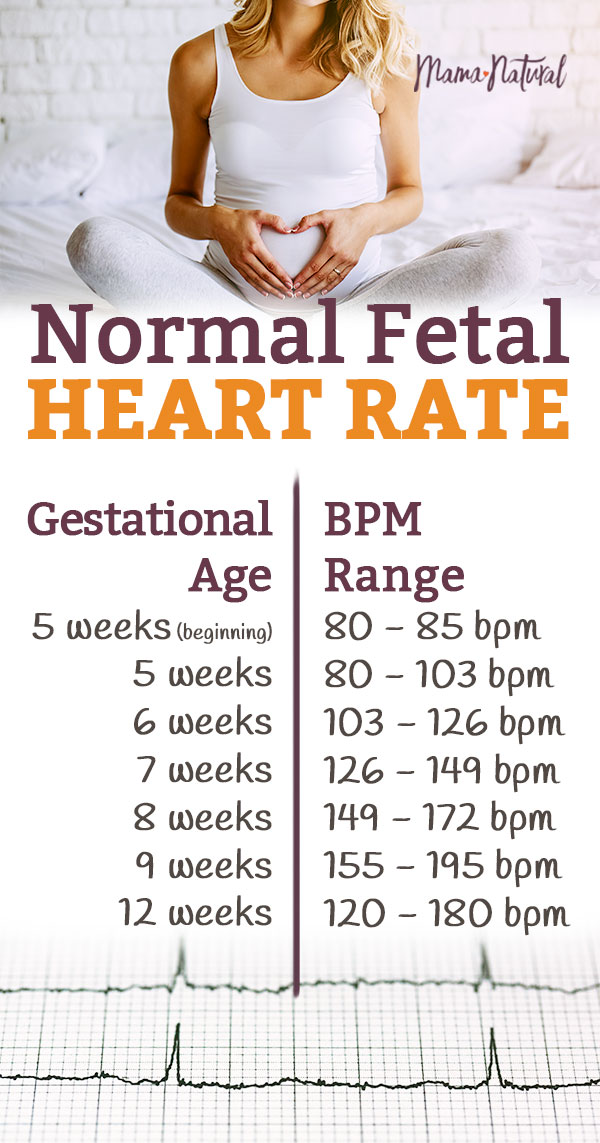
Merely information technology's important to note that the heart charge per unit can, and does, change depending on the gestational historic period of the baby. When the heart is first beating and nonetheless developing, it is normal for the fetal heart charge per unit to start out at a much slower rate, increasing daily, until information technology starts to stabilize and beat inside the expected range around the twelfth week of pregnancy.
Take a peek at this fetal heart rate chart to get an idea of how information technology changes week to week:
Normal Fetal Heart Rate Is Your Baby on Rail pregnancy mail service by Mama Natural
Once baby is born, he/she will maintain the 120-160 bpm boilerplate range for the first few hours, only after that:
- The neonate (first 28 days of life): 100-165 bpm while awake and 90-160 bpm while asleep (source)
- 1-2 months: 100-150 bpm while awake and ninety-160 bpm while sleeping
- i yr: 70-110 bpm while awake and 80-120 bpm while sleeping
- 12 years old: 60-100 bpm—close to that of an developed.
Fascinating, isn't it?
Pregnant? Get my Gratis week-by-calendar week updates! – Week by Calendar week Promo [In-commodity]
Track your baby's growth, find prophylactic and natural remedies, and have fun along the mode!
Get Pregnancy Updates!
What If Babe's Heart Rate Doesn't Fall Within the Normal Range?
It can be severely anxiety-inducing to discover baby doesn't have a normal fetal middle rate. Remember: Baby's heart rate isn't always consequent in the early stages of pregnancy. Information technology varies from baby to baby and even pregnancy to pregnancy.
The following factors, many of which are relatively benign, may affect infant's heart rate:
- Gestational age: A baby'south heart charge per unit starts out slower in the very starting time, then speeds up. It levels off to the normal fetal heart rate range of 120-160 bpm by mid-pregnancy. If your baby's middle rate is out of range, check your due date first. There'south a run a risk dating is off!
- Blood sugar levels: When accounting for maternal age, BMI, diabetes duration, and gestational week, researchers found higher glucose levels correlated to a higher fetal eye rate. Similarly, low blood glucose levels contribute to a lower fetal heart rate.
- Fetal activity: Equally baby develops, and then does the nervous organization. And our parasympathetic nervous system is what makes our heart rates go upwards or down based on action or stress. If babe is sleeping in at that place, he/she will have a lower heart rate; If babe is active, he/she will accept a higher centre rate. This variability is a practiced thing — studies evidence heart charge per unit variability is one of the all-time markers of fetal wellness, as information technology shows resiliency.
- Mama's diet: Nutrient and beverages like coffee, chocolate, and sugar are stimulants, and tin can affect whether baby has a normal fetal heart charge per unit at that moment. If you consume these things prior to an ultrasound, it tin can cause a temporary increase in eye charge per unit.
A normal fetal middle rate is an indicator of good fetal health. A baby may be in distress if their heart charge per unit falls outside of the normal fetal middle rate range. Unfortunately, an abnormal fetal heart rate tin can indicate a heart condition or a miscarriage in process.However, the odds are in your favor that you'll take a healthy infant.
It's of import not to jump to conclusions, though.Heart charge per unit can exist measured incorrectly and/or fluctuate significantly. Most midwives or doctors won't diagnose a genetic condition or a miscarriage on ane heartbeat reading. You lot may have a follow-up ultrasound or take HCG levels tested.
If y'all are concerned nigh your baby's heart rate, talk to your provider—there's probable a good explanation!
Help! Doppler vs. Fetoscope
If y'all oasis't yet hear baby's heartbeat for the first fourth dimension, y'all may be wondering about your choices.
Fetoscopes are safe and behave no take chances, but you have to await to hear baby'south heartbeat. There is some bear witness that dopplers expose the fetus to extra high-frequency waves. However, in the care of a professional person who knows how to operate them, they are generally regarded as safe.
Learn more nearly fetal eye monitors in this mail.
Can I Use an At-Habitation Fetal Monitor to Check Infant'south Heart Charge per unit?
Every bit a general rule, calm fetal monitors are not recommended. A lot of mamas purchase these pocket dopplers, for reassurance and to connect with babe on a regular footing. While that'south tempting, these devices are not canonical by the Nutrient and Drug Assistants.
Although there is a lack of prove of whatever harm due to ultrasound imaging and heartbeat monitors, prudent utilize of these devices past trained healthcare providers is important. Ultrasound can heat tissues slightly, and in some cases, it can too produce very small bubbles (cavitation) in some tissues. — Shahram Vaezy, a biological engineer from the FDA
The long-term furnishings of tissue heating and cavitation are not known. Therefore, fetal center monitors should be done only when there is a medical need by trained professionals, including midwives and doctors.
Can Baby's Heart Rate Predict Baby's Sex?
Studies have debunked this gender predictor (the sometime wives' tales say girls' heartbeats are faster and boys are slower), but many midwives and mamas swear by it.
Fetal heart charge per unit can change often — going up or down — for reasons that take zippo to do with babe's sex.
Nevertheless, it can be fun to guess. You might speculate that baby's a boy if the heartbeat is consistently in the low 130s!
Likewise, fun fact: During labor girls exercise tend to as well accept a higher center rate.
How Most Yous?
What is your feel with fetal center charge per unit? How did y'all experience when you beginning heard it? Did your baby's fall inside range of the normal fetal heart charge per unit?
Source: https://www.mamanatural.com/normal-fetal-heart-rate/
0 Response to "Baby Heart Rate 165 at 11 Weeks Boy or Girl"
Postar um comentário